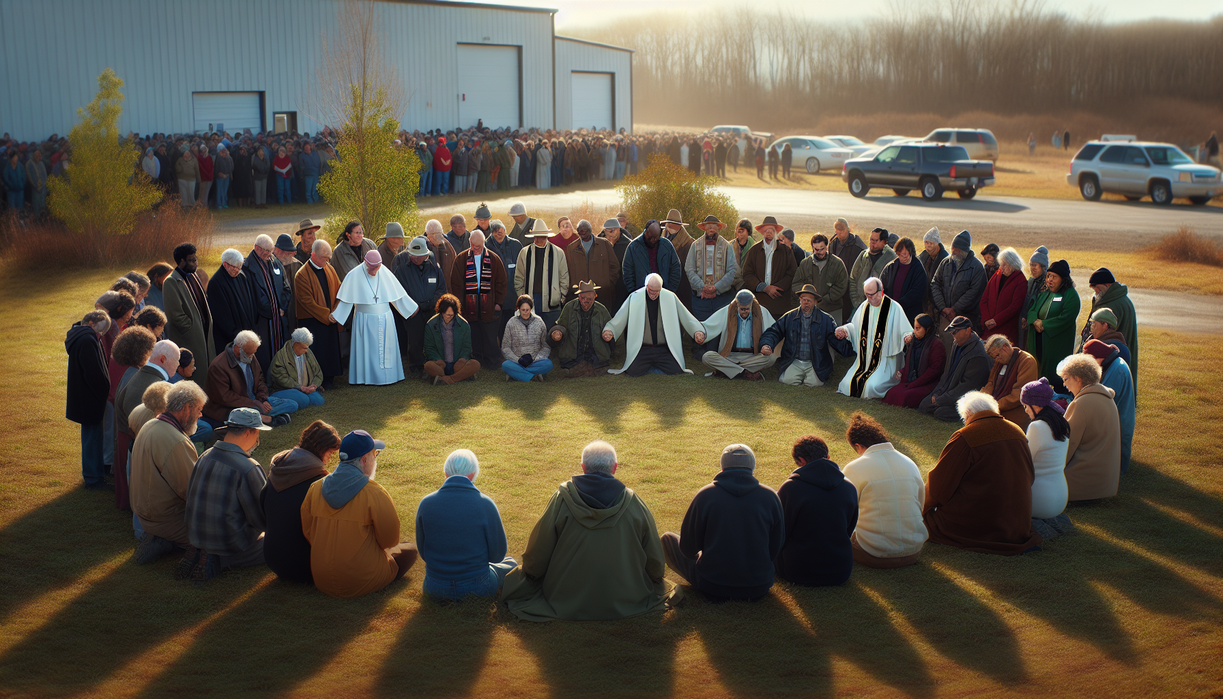

abetterwoman.net – On a quiet Sunday in Oakwood, the usual stillness of an industrial block took on a different content context. Roughly two dozen clergy and neighbors gathered near a nondescript warehouse, a space federal officials are eyeing as an Immigration and Customs Enforcement detention center. Their purpose was simple but weighty: to pray, to lament, and to declare that turning a warehouse into a place of confinement for vulnerable migrants clashes with the heart of their faith.
This vigil did more than mark opposition to a single project; it reframed the entire debate through a moral content context. Instead of abstract policy arguments, the scene focused on flesh‑and‑blood neighbors, biblical values of hospitality, and the spiritual cost of normalizing detention. By praying in public, these clergy placed conscience at the center of a civic conversation usually dominated by legal jargon and political spin.
Reframing the Debate Through Content Context
The phrase content context might sound academic, yet it matters deeply in this moment. Policies do not emerge in a vacuum; they are built from stories, images, and assumptions repeated until they feel inevitable. When officials describe a proposed ICE facility as a mere “processing center” or “warehouse conversion,” the content context strips away human faces. It becomes easier to treat migrants as logistics problems instead of people experiencing fear, hope, and trauma.
The Oakwood vigil disrupted that narrative by injecting a different content context into public view. Instead of bureaucratic language, the air carried prayers, hymns, and testimonies about families torn apart by enforcement. Instead of technical briefings, clergy spoke of Jesus as a refugee child fleeing violence. This shift did not change zoning codes or federal contracts overnight, but it did challenge the moral assumptions beneath them.
As a writer observing from a distance, I see this as a contest between two competing content contexts. One frames detention as management of risk and order. The other frames it as a spiritual crisis about how a community treats strangers at its gates. The outcome will not be decided solely in courtrooms or council meetings. It will be shaped by which content context captures the moral imagination of Oakwood—and of the country.
Why Clergy Call the Facility “Un‑Christlike”
Many of the clergy at the vigil reportedly described the proposed detention site as “un‑Christlike.” That phrase might strike some as rhetorical overreach, yet, within the Christian content context, it carries specific meaning. The Gospels present Jesus as someone who identifies with the hungry, the imprisoned, and the foreigner. “I was a stranger and you welcomed me,” he says in one well‑known passage. For believers who take this seriously, locking up migrants for civil violations conflicts directly with their understanding of discipleship.
From this theological content context, faith is not limited to personal piety or Sunday rituals. It extends to how a society structures its institutions. If prayer shapes hearts but ignores the cages in which people sleep, something essential has been lost. That is why kneeling in the shadow of an abandoned warehouse matters. It visually insists that the fate of people who might be held there belongs inside the circle of Christian concern, not outside it.
Critics might argue that clergy should stay out of immigration policy, leaving it to experts. Yet even that objection carries its own content context: it assumes morality can be separated from governance. The Oakwood vigil rejects that split. It suggests that technical decisions about detention locations cannot be ethically neutral. They either deepen a culture of exclusion or move a community toward hospitality. In that sense, calling the plan un‑Christlike is less a partisan slogan than a moral verdict drawn from a specific faith tradition.
Community Resistance and the Stories We Choose
What strikes me most about this moment is how ordinary it appears on the surface: twenty‑five people, a warehouse, some quiet prayers. Yet within that modest scene lies a potent struggle over content context and, ultimately, over identity. Will Oakwood become another dot on a map of hidden detention sites, or a town remembered for resisting that transformation? Community members now face a choice about which stories to elevate—tales of fear and control, or narratives grounded in welcome and solidarity. My perspective is clear: when we center the lived experiences of migrants, guided by spiritual traditions that honor human dignity, we gain a richer content context for public decisions. That deeper lens does not resolve every policy question, but it keeps us from forgetting the most important one: who are we becoming when we build places meant to hold our neighbors behind locked doors?