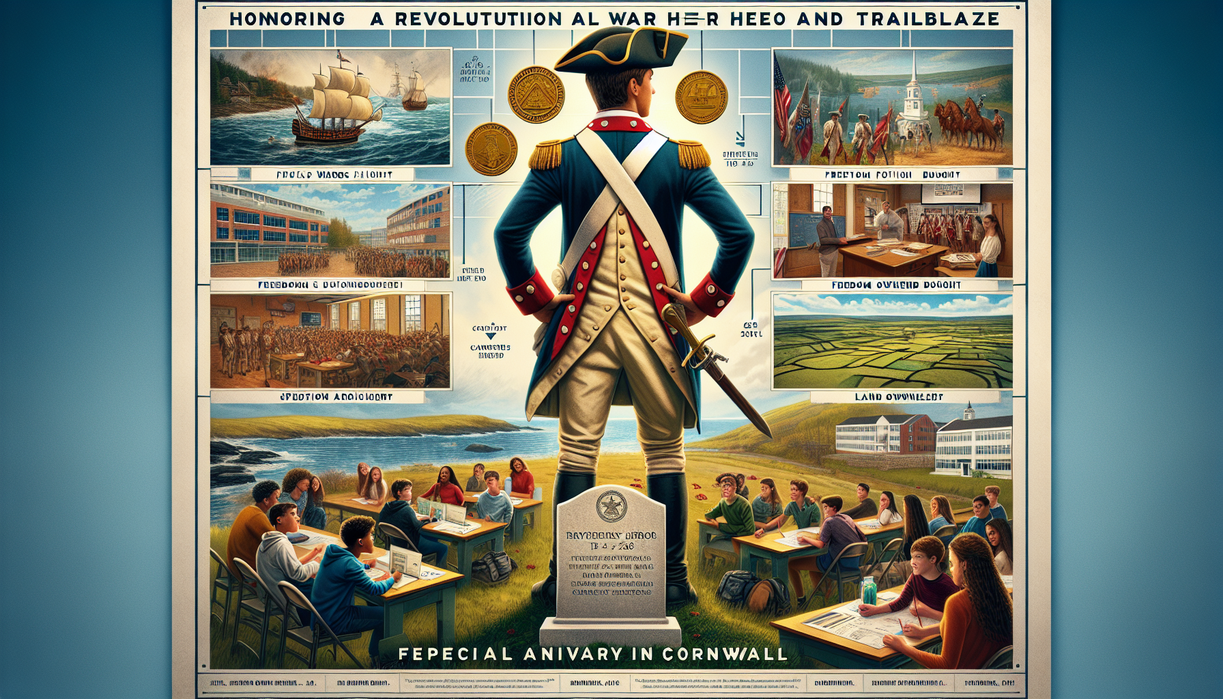

abetterwoman.net – Every black history month invites us to look again at stories of courage that once hid in the margins. This year, the town of Cornwall has turned its attention to Robin Starr, a Black Revolutionary War veteran who journeyed from enslavement to self-emancipation. By declaring February 8 as Robin Starr Day, the community places his life squarely within the broader narrative of American freedom. His story complicates easy myths, but it also offers a powerful lens on resilience, sacrifice, and the unfinished work of remembering.
Though records on Starr are limited, what we do know reshapes how we view the Revolution during black history month. Here was a man born in bondage, who risked everything on a battlefield for a nation that still denied his humanity. Later, he steadily gathered the means to buy his own freedom, creating a legacy that refuses to be forgotten. Cornwall’s decision to honor him is both a local tribute and a national reminder: our commemorations are strongest when they include those once pushed to the edges of the page.
Robin Starr Day and the Power of Local Memory
The establishment of Robin Starr Day in Cornwall gives this year’s black history month a distinctly local heartbeat. Instead of focusing only on well-known figures, the town chose to spotlight a man whose name never appeared in school textbooks. This decision matters. Memory often begins in small places, with people who decide a particular life should be carried forward. By choosing a specific date, February 8, Cornwall turns remembrance into a recurring civic ritual, not a one-time gesture.
Local memory can be more than plaques or speeches. It can influence how neighbors talk about the past with their children. Parents can point to Robin Starr Day on the calendar, tell the story of a Black soldier who fought in the Revolutionary War, then link it to broader black history month themes of resistance and self-determination. Over time, that repeated conversation can shift what young people consider normal, expected, even admirable in their own lives.
There is also a quiet radicalism in placing a former slave at the center of town history. For generations, many communities highlighted only landowners, politicians, or officers. In contrast, Cornwall is choosing a man whose life tested the limits of the era’s ideals. That choice suggests a deeper understanding: national independence means little if freedom remains selective. A holiday for Robin Starr implicitly asks residents to wrestle with that contradiction, not just celebrate past victories.
From Enslavement to Soldier: A Complicated Freedom
Robin Starr’s life fits squarely into the layered story we revisit every black history month. Enslaved at a time when colonial rhetoric shouted about liberty, he nonetheless entered the Revolutionary War on the side of a nation that kept him in chains. Some enslaved men were promised freedom for military service; others saw enlistment as a narrow path to survival or leverage. Whatever the specific terms of Starr’s service, his choice reflects a hard calculation: fight for a vision of freedom that might never include you, or remain bound to a system built on your silence.
His eventual purchase of his own freedom marks one of the most wrenching ironies of early American history. A man who risked his life for independence then had to raise money to buy the very autonomy he defended in battle. For me, this detail underscores how incomplete the Revolution remained for Black people. In many accounts told outside black history month, the war ends with triumphant independence. Robin Starr’s story forces us to ask a harder question: independence for whom, under what terms, at what cost?
Looking at Starr’s path through that lens changes how we view heroism. He was not a symbol carved in marble. He was a human being making impossible choices in a violent system. His achievements sit alongside the reality that he had to pull himself out of enslavement through grueling effort. That tension should make us uneasy. Yet it also reveals a fierce capacity for hope. In a world stacked against him, he still believed his life was worth investing in, worth reclaiming, worth living as a free man.
Black History Month, Small Towns, and Shared Responsibility
When a small town like Cornwall adds Robin Starr Day to its calendar during black history month, it is quietly rewriting the story of who belongs at the center of American memory. It sends a clear message: Black contributions to the nation are not confined to distant metropolises or famous names. They exist in churchyards, local archives, and unmarked graves. To me, that realization carries a personal challenge. Wherever we live, we share a responsibility to ask who has been left out of the narrative. We can attend events, support preservation efforts, push schools to include local Black history, and resist the comfort of a simplified past. Honoring figures such as Robin Starr is not about polishing a patriotic myth; it is about facing the truth that freedom in this country has always been unevenly distributed. A reflective black history month acknowledges that injustice while still recognizing courage wherever it appears, especially in lives once treated as expendable.